
What is Karate?
Karate (from Japanese: "empty hand"; originally "Te" — hand) is a martial art that developed in Okinawa. The method combines strikes, grappling, takedowns and ground fighting, emphasising maximum efficiency — neutralizing an opponent with a minimum number of decisive actions.
From Okinawa, karate spread to Japan and from there to the rest of the world, continuing to develop as a tool for personal growth, mind-body training and competitive sport.
Today there are many streams and styles, all resting on three central pillars:
- Kata — a fixed sequence of fighting movements performed against imaginary opponents
- Kumite — sparring / combat
- Bunkai — the practical application of kata movements, bridging kata and real combat
Our Karate
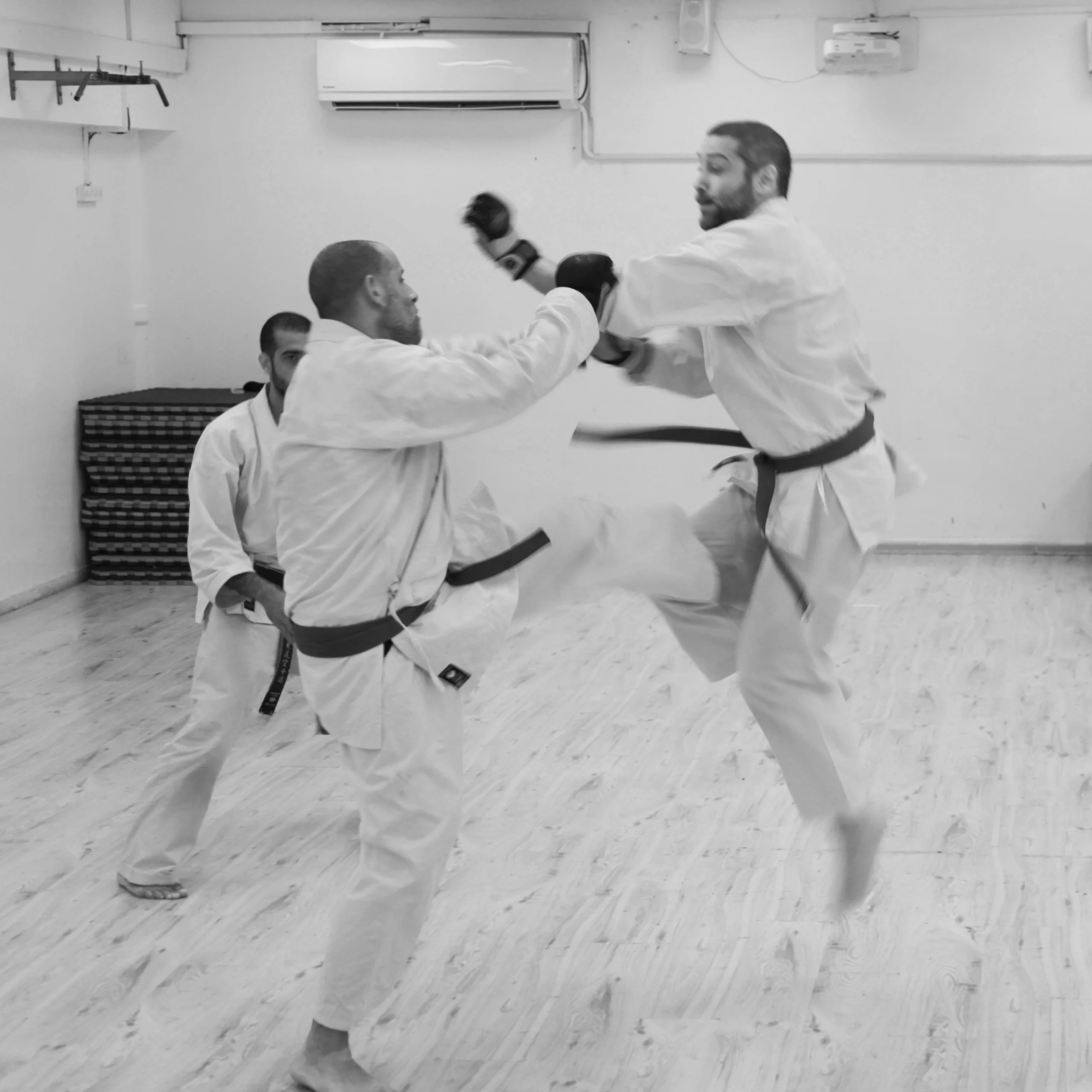
Our karate is a modern karate born from the stream known as Shito Ryū (Shito Ryū 東恩納). We specialize in free bare-handed combat, without protective gear, without rules, without restrictions, without a referee, without points — and without winners or losers. In sparring, anything goes, while maintaining full safety and mutual responsibility.
Training sessions are varied, health-oriented and in-depth, and include:
Each session begins gradually, preparing every tissue for the expected demands and minimizing the risk of injury.
Every session includes practice of falls and rolls on a hard floor, to preserve and develop this vital skill.
We strive for a strong, flexible and adaptable body: handstands, animal-inspired movement and exercises that expand the movement repertoire.
To develop physical and mental resilience, we practice controlled impact absorption on bones and muscles.
Classic strength exercises (such as push-ups) are integrated into the training.
Hand and leg blocks, punches, open-hand strikes, elbows, kicks and knees; chokes; joint locks; throws; ground work; weapon disarms.
A meaningful tool for solo practice — improves posture, balance, coordination, agility and explosive power. Also serves as a meditative tool and a means of personal expression.
The link between kata and combat — applications of kata movements that meet the standards of self-defence and modern fighting.
Free bare-handed combat is practiced through a variety of sparring drills and combat games, with and without protective gear.
Additional fighting approaches, including weapon work, are incorporated into sessions led by the senseis and guest instructors.
Syllabus & Video Materials
Each student receives a personalized training program tailored to their grade, detailing the material being studied and guidance for further progress. In addition, instructional videos are available for home practice.

Self-Defense
Tools for dealing with the most common attacks, usually from an unskilled attacker
From the very first session you will leave with practical tools and a sense of capability. Within a few sessions you will have responses to the most common attacks. After an intensive learning period, periodic maintenance training is required to retain the skills.
- Harassment & threats
- Grabs & pushes
- Strikes
- Knife attacks
- Multiple attackers
About the Dojo
The dojo has been operating continuously since June 1996. A variety of ages and grades train together in a family-like, respectful and supportive atmosphere. The dojo is called "KI ME KAN":
Ki — Power · Energy · Breath
Me — Eye · Mirror of the inner soul
Kan — House · School
Together: "The School of Inner Power"
The Teachers
Barak and Amit Hadad
Practicing karate and self-defense for over 30 years, teaching for over 20 years,
and active in instructor and teacher training for over 13 years

Practitioner of natural medicine in a private clinic (OCTOPUS Clinic & Movement), lecturer and instructor in martial arts instructor training courses at Sports Academy.
· 2005–2006: Certified as a Karate instructor by the Wingate Institute.
· 2013: Certified as a practitioner of Chinese medicine (LicAc) and opened his clinic.
· Regularly trains and continues his education in various martial arts and diverse movement disciplines.
In his therapeutic work, Barak integrates acupuncture, manual therapy, herbal medicine, supportive conversation, and rehabilitative movement. On Thursdays at 19:15 he holds Flowmotion sessions in the dojo, providing patients and practitioners with movement fundamentals that support the body's overall health.
Dojo Founders
The Ki Me Kan karate club was founded in 1996 by Sensei Ehud Hadad (5th Dan) and Sensei Zvika Margoninsky (8th Dan). The club was established as a direct continuation of their professional path, after their teachers — Yossi Shachnowitz and Itzik Florentin of the "San Shin Kan" club — left the country. Out of a desire to preserve the spirit of learning, the values and the tradition they had been raised on, they chose to establish an independent framework to continue and develop that path.

Ehud Hadad

Zvika Margoninsky


Our Community
Beyond being a place for professional karate and self-defense training, the dojo is an active and close-knit community framework. The atmosphere is warm, respectful and supportive, giving rise to meaningful personal connections and long-lasting friendships. The group is diverse: women and men, children and adults, at every level — beginners and advanced — all training together. Entire families train together too: couples, parents and their children, grandparent and grandchild. Everyone learns from everyone.
Membership Plans
Youth and adults are required to complete a health declaration form before starting training
We'd Love to Hear from You
Leave your details and we'll get back to you shortly
Frequently Asked Questions
Are there trial lessons?
Absolutely! Until you feel right at home.
What should I wear to the first session?
If you don't have a training gi, just come in comfortable clothing — no vests, no shorts that are too short or too baggy. Just comfortable. Training is done barefoot and without jewellery.
Beginners and advanced students together — how does that work?
There are two teachers at most sessions, so in many sessions the group is divided by level. In addition, we combine uniform training with a personal track where each student can progress according to the material that matches their grade.
What time should I arrive for my first session?
It's worth arriving at least fifteen minutes early — to get acquainted, warm up and ease into the atmosphere.
I have a background in another karate style — do I need to come with a white belt?
As a guest, you're welcome to come with your grade from the other system. If you register, you start with a white belt because there is an organised syllabus to learn — but your progression will be fast and personalized.